
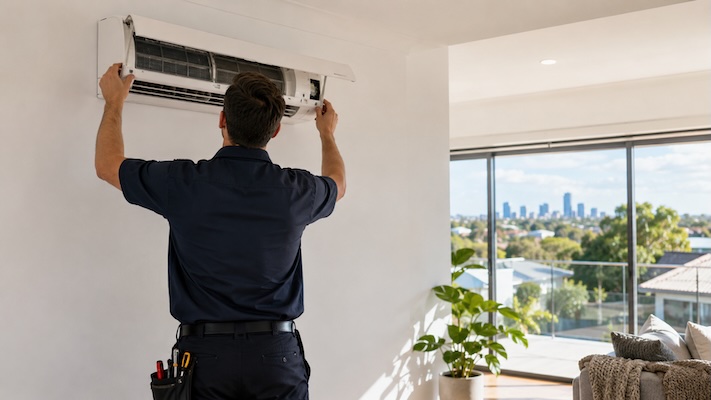
Choose the Perfect Size Air Con for Your Property
Quick summary: Choosing the wrong air con size is one of the most common and costly mistakes Perth homeowners make. Too small and your system runs constantly without cooling properly. Too large and you waste money on power bills and wear out your unit faster. This guide walks you through exactly how to size an air conditioner for a Perth home, what factors affect your calculation, and how to get it right the first time.
Perth summers are no joke. With temperatures regularly hitting 40°C and a climate unlike anywhere else on the east coast, sizing your air conditioner correctly is not just a comfort issue. It directly affects your energy bills, the lifespan of your system, and how well your home actually cools down on the days you need it most.
Our team at Hurricane Air has been installing and servicing air conditioning systems across Perth for over 15 years. The question we hear more than any other is: “What size air con do I need?” This guide answers that in full.
The starting point: kilowatts and room size
Air conditioner capacity is measured in kilowatts (kW). As a general rule, you need roughly 0.125 kW of cooling capacity per square metre of floor space. So a 20m² bedroom would typically need a 2.5 kW unit, while a 40m² open-plan kitchen and living area might need 5 kW.
However, this is just the starting point. Perth-specific conditions and your home’s construction mean the real number is almost always higher than a basic calculation suggests.
General capacity guide by room size
| Room size | Recommended capacity | Typical room type |
| Up to 20m² | 2.0 – 2.5 kW | Small bedroom, study |
| 20 – 30m² | 2.5 – 3.5 kW | Master bedroom, large bedroom |
| 30 – 45m² | 3.5 – 5.0 kW | Small living area, open kitchen |
| 45 – 65m² | 5.0 – 7.0 kW | Medium living and dining |
| 65 – 90m² | 7.0 – 9.0 kW | Large open-plan area |
| 90m² and above | 9.0 kW+ | Extra-large open plan, commercial |
Want a quick estimate based on your specific rooms? Use our free air con size calculator to get a starting figure tailored to your home.
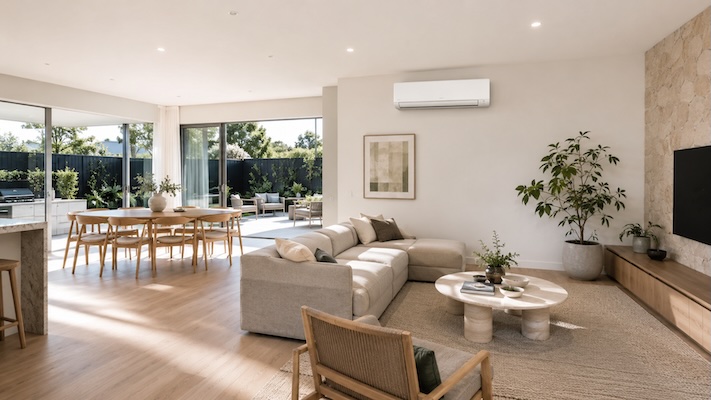
Factors that change the calculation for Perth homes
Raw floor area is only one piece of the puzzle. In Perth, several factors can push your required capacity significantly higher than the base estimate.
1. Ceiling height
Standard capacity estimates assume a ceiling height of around 2.4 metres. If your home has high ceilings — common in Federation-era or architecturally designed homes, the volume of air being cooled increases considerably. Add roughly 10–15% capacity for ceilings above 2.7 metres.
2. Insulation quality
Homes built before the mid-2000s often have little to no ceiling insulation and minimal wall insulation. Poor insulation means heat pours in through the roof and walls on hot days, forcing your system to work much harder. A well-insulated home can often get away with a smaller unit than an equivalent poorly insulated home.
3. Window size and orientation
North and west-facing windows in Perth receive intense afternoon sun. A room with large west-facing windows can require up to 30% more cooling capacity than the same room facing south. Heavy curtains, external blinds, and double glazing all reduce this load significantly.
4. Number of occupants
Each person in a room adds approximately 80W of heat load. For a living room regularly used by a family of five, that adds up. High-traffic rooms like open-plan family areas should have this factored in.
5. Appliances and lighting
Kitchens with ovens, cooktops, and multiple appliances generate substantial heat. Older halogen or incandescent lighting also contributes. LED lighting and induction cooktops reduce this load noticeably.
6. Home construction type
Brick veneer, double brick, and lightweight (weatherboard or steel-frame) homes all have different thermal mass and heat retention properties. Double brick homes in Perth are common and tend to stay cooler longer, but can take more energy to cool down once they heat up.
Split system vs ducted: does size work differently?
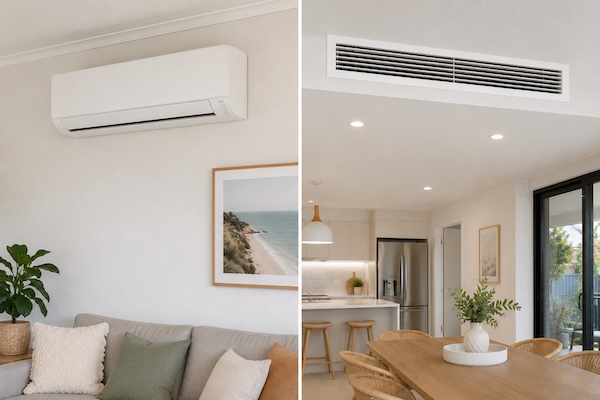
The sizing principles are the same whether you are looking at a split system or a ducted system, but how you apply them differs.
| System type | How sizing works | Best suited for | Key consideration |
| Split system | Size per individual room or zone | Single rooms, apartments, targeted cooling | Multiple units needed for whole-home coverage |
| Ducted system | Total load across all zones served by one outdoor unit | Whole-home cooling, new builds, larger homes | Duct layout and zone design affects performance significantly |
| Multi-split system | Multiple indoor units on one outdoor unit, each sized per room | Homes wanting room-by-room control without ducting | Outdoor unit capacity must match total indoor unit load |
Not sure which system type suits your home? Our full range of air conditioning services covers everything from single split systems to complete ducted installations across Perth.
Common sizing mistakes to avoid
- Going by price, not capacity. A cheaper, lower-capacity unit costs more to run in the long term and will not cool your home properly on the hottest days.
- Forgetting the outdoor unit location. An outdoor unit in direct afternoon sun in Perth runs less efficiently. Factor this into your overall system performance expectations.
- Ignoring the whole home. If you are installing multiple split systems, plan the total load across the home rather than each room in isolation. You may find a ducted system works out better value.
- Using east-coast sizing guides. Many online calculators use climate data from Sydney or Melbourne. Perth summers are hotter and drier, which means you generally need more capacity than those guides suggest.
How to get an accurate size for your home
The most reliable way to size an air conditioner is through a proper heat load calculation, also called a Manual J calculation. This takes into account all the variables listed above — room dimensions, insulation, window area and orientation, local climate data, and construction type — to give you a precise figure.
A qualified technician will assess your home and recommend a unit that handles both typical conditions and Perth’s peak summer days without being so oversized that it wastes energy the rest of the year.
As a starting point, use our free air con size calculator to get an estimate before booking a site visit. It takes under two minutes and gives you a solid baseline to work from.
Quick reference: sizing adjustments for Perth conditions
| Factor | Adjustment to base capacity |
| Ceilings above 2.7m | Add 10 – 15% |
| Poor or no ceiling insulation | Add 15 – 25% |
| Large west or north-facing windows | Add 10 – 30% |
| External shading or double glazing | Reduce 10 – 15% |
| High occupancy room (5+ people) | Add 5 – 10% |
| Kitchen or high-appliance area | Add 10 – 20% |
| Outdoor unit in direct afternoon sun | Account for reduced efficiency |
Get the right size air con installed in Perth – talk to a local expert today
Choosing the correct air conditioner size for your Perth home does not have to be complicated, but it does require getting the details right. At Hurricane Air, our licensed technicians assess your home properly and recommend systems that perform in our local climate.
Whether you need a single split system for a bedroom, a multi-room solution, or a full ducted installation, we provide honest, upfront pricing with no hidden fees.
Start with our free air con size calculator for an instant estimate, or contact our Perth team to book a free quote. You can also learn more about our air conditioning services or find out more about Hurricane Air and why Perth homeowners have trusted us for over 15 years.
